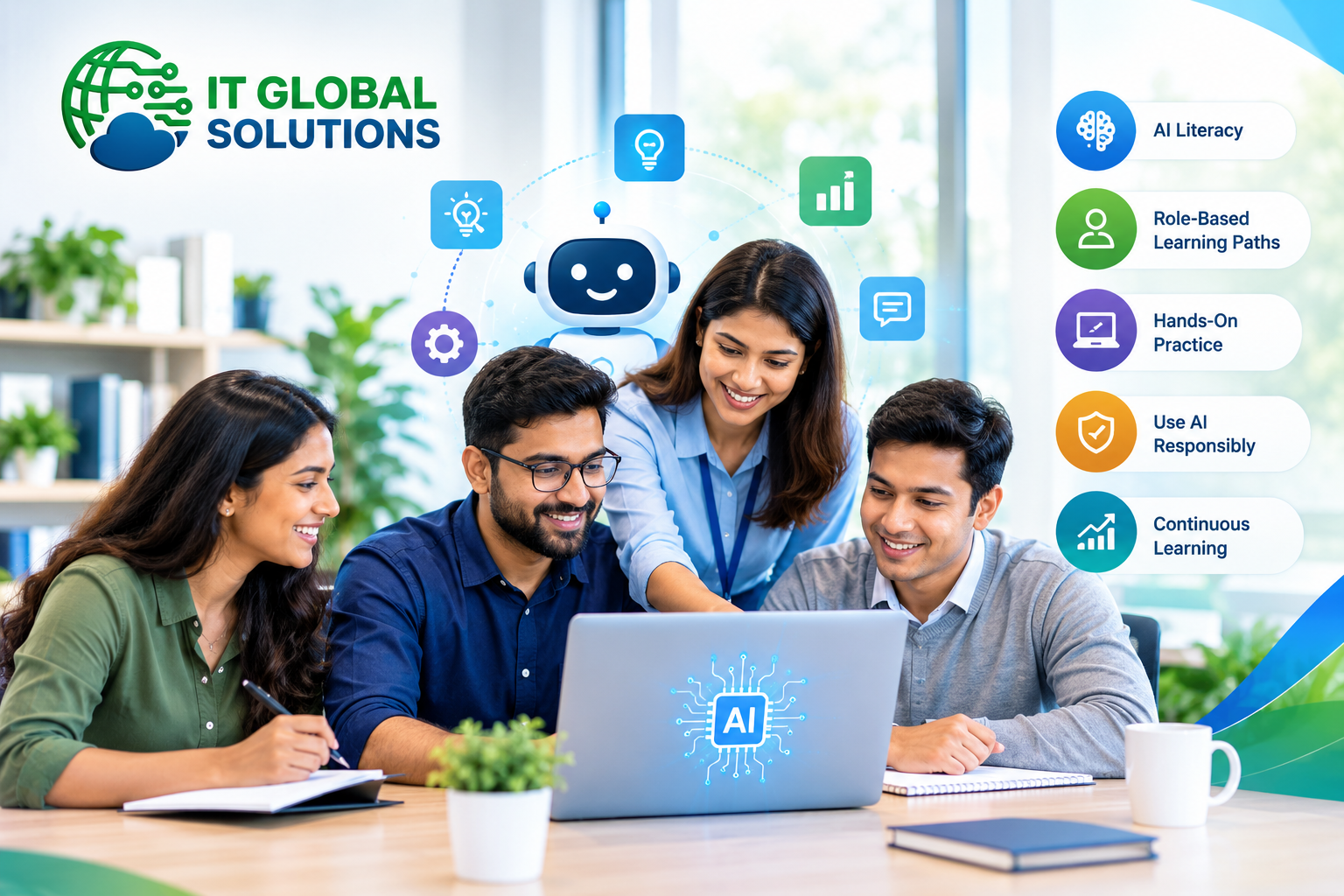
Artificial intelligence is no longer limited to IT departments, data scientists, or technology companies. Today, AI is becoming part of everyday work across marketing, human resources, finance, customer service, sales, operations, and many other business functions.
As organizations increasingly adopt AI-powered tools, one challenge has become clear: employees do not need to be technical experts to work effectively with AI, but they do need the right knowledge and skills.
For businesses, this makes employee training more important than ever. Non-technical employees need practical guidance to understand what AI can do, how to use it responsibly, and how it can support their daily work.
This is where a well-designed learning strategy and a modern Learning Management System (LMS) can make a significant difference.
Why Non-Technical Employees Need AI Training
Many organizations introduce new AI tools without providing employees with enough training. As a result, employees may feel confused, overwhelmed, or hesitant to use the technology.
Others may use AI tools without understanding their limitations or the potential risks involved.
Effective AI training helps employees:
- Understand the basics of artificial intelligence
- Identify how AI can support their daily responsibilities
- Use AI tools more confidently
- Improve productivity and efficiency
- Recognize inaccurate or unreliable AI-generated information
- Follow responsible AI practices
- Adapt to changing workplace technologies
The goal is not to turn every employee into a programmer or AI specialist. Instead, organizations should focus on helping employees become AI-aware, AI-confident, and capable of using AI responsibly.
1. Start With AI Literacy, Not Technical Complexity
One of the biggest mistakes organizations make is starting AI training with complex technical concepts.
Most non-technical employees do not need to understand how machine learning models are built or how algorithms are programmed. They need to understand how AI affects their work.
Start with simple and practical topics such as:
- What is artificial intelligence?
- How does generative AI work?
- What can AI tools do?
- What are the limitations of AI?
- How can AI support everyday tasks?
- What information should not be shared with AI tools?
Training should use clear language and real-world examples rather than technical jargon.
For example, a marketing employee may learn how AI can help generate content ideas, while an HR professional may explore how AI can support employee communication and learning.
When employees can connect AI training to their daily responsibilities, learning becomes more relevant and engaging.
2. Create Role-Based AI Learning Programs
A one-size-fits-all AI training program is unlikely to meet the needs of every employee.
Different teams use AI in different ways. Therefore, organizations should create role-based learning paths that focus on practical applications.
For Marketing Teams
Training can cover:
- AI-assisted content creation
- Research and idea generation
- Content personalization
- Campaign planning
- Responsible use of AI-generated content
For HR Teams
Employees can learn about:
- AI-supported recruitment processes
- Learning and development applications
- Employee engagement tools
- Responsible handling of employee data
For Customer Service Teams
Training can focus on:
- AI-powered customer support
- Chatbots and virtual assistants
- Improving response quality
- Maintaining the human element in customer interactions
A modern LMS can help organizations create personalized learning paths for different roles, departments, and skill levels.
3. Focus on Practical, Hands-On Learning
Employees learn AI best when they can see how it works in practice.
Instead of relying only on presentations and theoretical courses, organizations should include interactive learning experiences.
This can include:
- Real-world AI scenarios
- Interactive simulations
- Practical exercises
- AI tool demonstrations
- Case studies
- Scenario-based assessments
For example, employees can be given a common workplace task and asked to explore how AI could help them complete it more efficiently.
Hands-on learning allows employees to experiment in a structured environment. It also helps reduce the fear that often comes with adopting new technology.
4. Teach Employees How to Ask Better Questions
Using AI effectively is not simply about opening a tool and typing a request.
The quality of the output often depends on the quality of the instructions provided. Employees should therefore learn how to communicate effectively with AI tools.
Training can help employees understand how to:
- Provide clear instructions
- Give relevant context
- Break complex tasks into smaller requests
- Review and refine AI-generated responses
- Ask follow-up questions
- Verify the final output
This skill is becoming increasingly valuable across different business functions.
Employees do not need technical coding skills to improve their interactions with AI. They simply need to learn how to use AI tools thoughtfully and strategically.
5. Make Responsible AI Use Part of Every Training Program
AI training should not focus only on productivity. Employees must also understand the importance of responsible and ethical AI use.
Organizations should provide clear guidance on:
- Data privacy
- Confidential business information
- Accuracy and fact-checking
- Bias in AI-generated content
- Copyright considerations
- Company policies for AI usage
Employees should understand that AI-generated information should not always be accepted without review.
AI can make mistakes, provide outdated information, or generate inaccurate responses. Human judgment remains essential.
A strong corporate training program should help employees understand both the opportunities and the limitations of AI.
6. Use Microlearning to Make AI Training More Accessible
AI is evolving quickly, which means employees may struggle to keep up with lengthy training programs.
Microlearning can make AI education easier to manage.
Instead of requiring employees to complete long courses, organizations can provide short and focused learning modules covering specific topics.
Examples include:
- A five-minute lesson on writing better AI prompts
- A short video about AI data privacy
- A quick guide to reviewing AI-generated content
- A practical exercise using an AI-powered workplace tool
These short learning experiences can fit easily into an employee’s workday.
An LMS can help organizations deliver, organize, and track these learning modules while giving employees the flexibility to learn at their own pace.
7. Encourage a Culture of Experimentation
Many employees are hesitant to use AI because they are afraid of making mistakes.
Organizations can address this by creating a safe environment for learning and experimentation.
Employees should be encouraged to:
- Explore approved AI tools
- Share useful AI use cases
- Discuss challenges and concerns
- Learn from successful experiments
- Collaborate with colleagues
Internal AI learning communities can also help employees exchange ideas and practical experiences.
When employees see how their colleagues are using AI successfully, they may feel more confident about experimenting with it themselves.
8. Support Continuous AI Learning
AI skills cannot be developed through a single training session.
Technology continues to change, and new AI tools and capabilities are introduced regularly. Organizations need to view AI training as an ongoing learning process.
A continuous learning strategy may include:
- Regular AI learning modules
- Monthly AI awareness sessions
- New tool demonstrations
- Updated learning content
- AI skills assessments
- Role-specific learning paths
A centralized LMS makes it easier to manage continuous learning initiatives and keep training content updated.
It also allows organizations to monitor participation, identify learning gaps, and provide additional support where needed.
9. Measure AI Training Outcomes
Organizations should not measure AI training success based only on course completion rates.
Instead, they should look at whether employees are actually developing useful skills and applying them in the workplace.
Important metrics may include:
- Employee confidence in using AI
- AI tool adoption rates
- Improvement in workplace productivity
- Knowledge assessment results
- Employee engagement with training
- Practical application of AI skills
Learning analytics available through an LMS can help organizations understand how employees are progressing and where additional training may be needed.