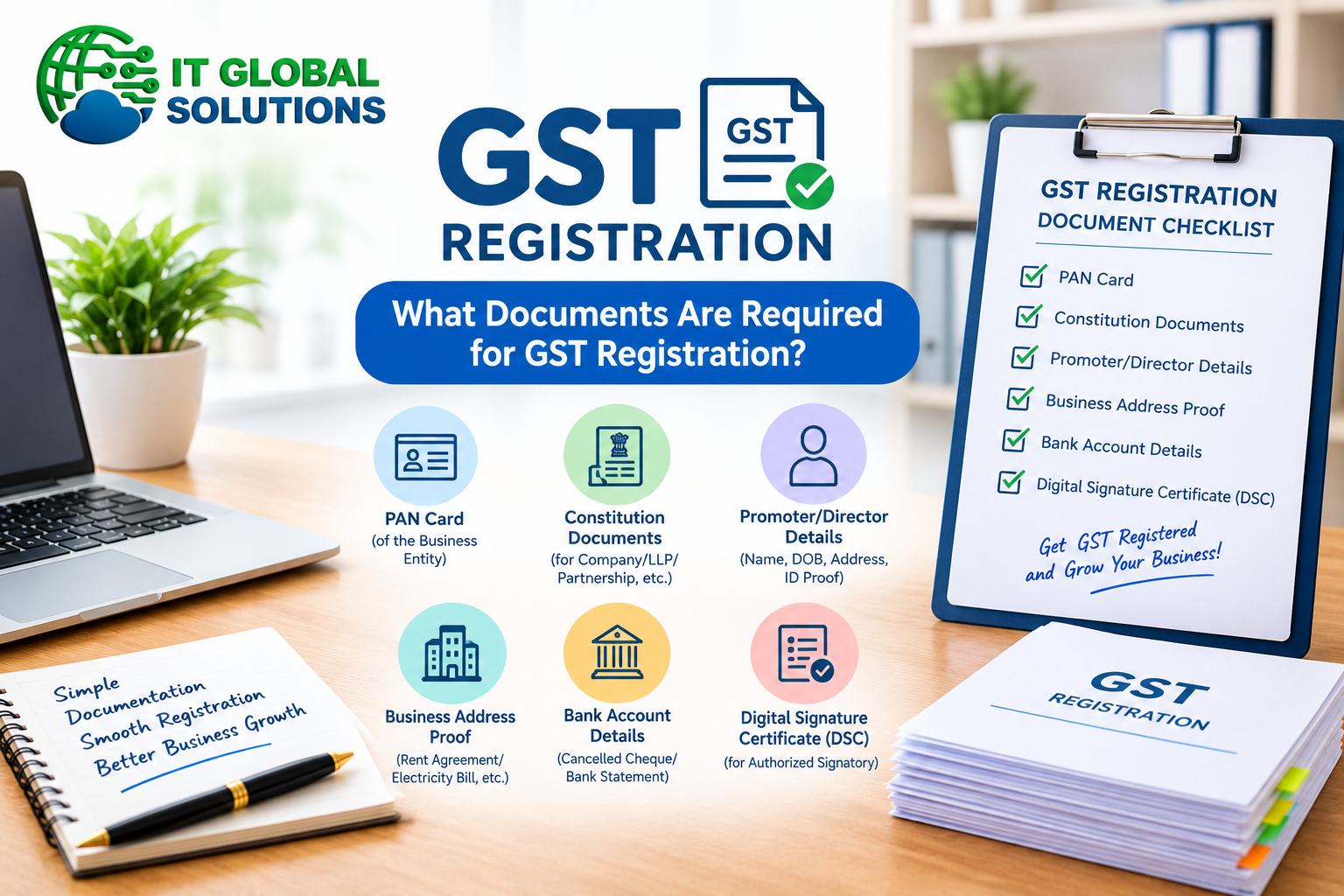
GST registration is an important compliance requirement for businesses that are liable to register under the Goods and Services Tax system in India. Whether you are starting a new business, expanding your operations, or providing taxable goods and services, having the right documents ready can make the registration process smoother.
For beginners, one of the most common questions is: What documents are required for GST registration? The answer depends on the type of business, ownership structure, and the nature of the premises from which the business operates.
In this guide, we’ll explain the commonly required documents for GST registration and share some practical tips to help you prepare your application correctly.
What Is GST Registration?
GST registration is the process through which an eligible business or taxpayer obtains a GSTIN (Goods and Services Tax Identification Number). The GST registration application is submitted electronically through the GST portal.
PAN is required for GST registration, and the application also requires business, promoter/partner, authorized signatory, and place-of-business details.
Once registration is granted, the taxpayer receives a GST registration certificate containing the GSTIN and relevant business details.
Documents Required for GST Registration
The exact documents can vary according to the constitution of the business. However, applicants generally need documents relating to the following areas.
1. PAN Card
PAN is one of the key requirements for GST registration. For a proprietorship, the proprietor’s PAN is used, while other business structures generally provide the PAN applicable to the entity.
The legal name entered in the GST application should correspond with the PAN records.
2. Proof of Constitution of Business
The documents required to establish the constitution of the business depend on its structure.
Depending on the entity, this may include documents such as:
- Partnership deed
- Certificate of Incorporation
- Trust deed
- Registration certificate
- Other documents supporting the constitution of the business
The GST registration process requires documentary information relating to the constitution of the business and its stakeholders.
3. Identity and Address Proof of Promoters, Partners, or Directors
Details and supporting information for promoters, partners, directors, or other relevant stakeholders may be required.
Depending on the business structure, the application can require information such as:
- PAN
- Aadhaar details
- Address details
- Date of birth
- Designation/status
- Photograph
The GST portal’s registration process includes dedicated sections for promoters/partners and authorized signatories.
4. Photograph of the Authorized Signatory
A photograph of the primary authorized signatory is required as part of the GST registration application.
The GST portal specifies file-format and size requirements for uploaded photographs, so documents should be prepared according to the portal’s current specifications.
5. Proof of Appointment of Authorized Signatory
If someone is authorized to act on behalf of the business, appropriate proof of appointment may be required.
Examples can include:
- Letter of authorization
- Board resolution
- Resolution of the managing committee
- Other applicable authorization documents
The official GST document checklist specifically includes proof of appointment of an authorized signatory.
6. Proof of Principal Place of Business
One of the most important parts of GST registration is providing proof of the principal place of business.
The documents can differ depending on whether the property is owned, rented, leased, or occupied with consent.
For an Owned Property
Possible documents include:
- Latest property tax receipt
- Municipal Khata copy
- Electricity bill
- Other acceptable ownership-related documents
For a Rented or Leased Property
You may need:
- Valid rent or lease agreement
- Supporting ownership document of the lessor, such as a property tax receipt, municipal Khata copy, or electricity bill
For Other Premises
Where the premises do not fall under the above categories, a consent letter along with supporting ownership/possession documentation may be used, subject to applicable GST requirements.
The GST portal’s current document checklist specifically lists these categories of premises-related documents.
7. Proof for Additional Place of Business
If your business operates from additional locations, details and supporting documents for those locations may also be required.
Depending on the nature of possession, documents can include:
- Property tax receipt
- Municipal Khata copy
- Electricity bill
- Rent or lease agreement
- Consent letter
- Government-issued documents or certificates
The GST portal provides similar documentation categories for additional places of business.
8. Bank Account Details
Bank account information may be relevant to GST compliance, but it’s important to distinguish the current registration process from older checklists.
The GST portal’s registration guidance states that bank account details in the registration application are optional, and taxpayers can add them later through a non-core amendment after GSTIN is granted.
Therefore, businesses should follow the requirements displayed on the GST portal at the time of application rather than relying on older checklists found online.
9. Digital Signature or Electronic Verification
The application must be authenticated electronically. The appropriate method depends on the type of taxpayer.
For example, the GST portal states that Digital Signature Certificate (DSC) is mandatory for LLPs and companies for electronically signing the application. Other eligible taxpayers may have different authentication options depending on the applicable process.